
When Winning Becomes a Habit: Younes Emami’s Growing Reliability at 74kg
An Olympic champion in the opening round, a familiar rival in the semifinal and a world champion in the final. Younes Emami’s second Asian Games gold was built on more than one spectacular victory. In Nagoya, the Iranian showed something that may matter even more at 74kg: an increasing ability to solve different problems and keep winning.
NAGOYA, Japan — Younes Emami could hardly have been given a more difficult way into an Asian Games tournament. His first opponent at 74 kg was Razambek Jamalov.
Not an emerging wrestler. Not someone hoping to break into the highest level. The reigning Olympic champion.
By the end of the day, things had not become much easier. Between Emami and another Asian Games gold stood Nurkozha Kaipanov, a former world champion at 70 kg and one of his oldest international rivals, followed by Yoshinosuke Aoyagi, the 2025 world champion at 70 kg, wrestling at home in Japan. Emami beat all three.
This was not a tournament in which one favorable draw opened the path to gold. Nor did Emami win every match in the same way. He had to survive a changing lead against an Olympic champion. He overwhelmed his next opponent. He controlled a familiar rival who had once repeatedly troubled him. Then, in the final, he had to come from behind against a world champion who had spent much of the day dismantling opponents.
An Olympic Champion in Round One
There was no time for Emami to ease himself into the tournament. Jamalov had won Olympic gold in Paris at 74 kg. Yet the draw placed the Uzbek (originally Russian) and the defending Asian Games champion together immediately.
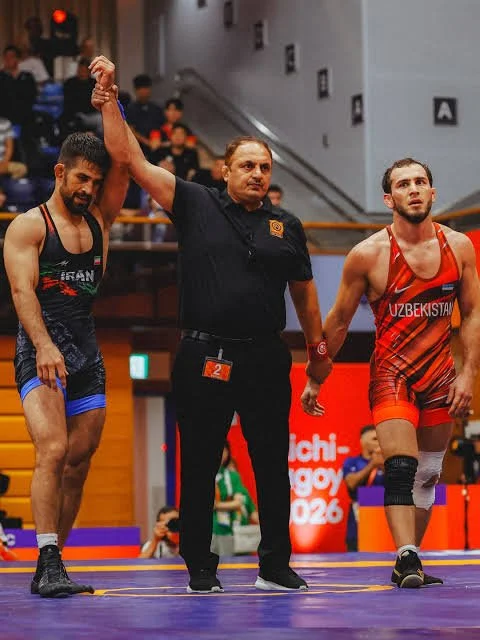
Emami led 3–2 at the break, but the match changed during a second-period scramble. Jamalov eventually moved ahead 6–5 after turning the Iranian. For Emami, the danger was obvious. His Asian Games title defense could have ended in his first match. Instead, the response was remarkably composed.
As Jamalov attempted a hip toss, Emami stayed in the exchange and finished the action with a takedown of his own. That put him back in front 7–6. This time, he kept the lead.
United World Wrestling specifically described Emami as keeping his composure during the decisive sequence. The 7–6 victory eliminated the Paris Olympic champion before the tournament had properly begun. Jamalov later lost in repechage and left Nagoya without a medal.
From Drama to Dominance
India's Sagar Jaglan presented the next problem. Emami answered it very differently. There was no one-point battle this time. He used his gut wrench to build the score and ended the quarterfinal 10–0.
Then came Nurkozha Kaipanov. For anyone looking only at the current version of their rivalry, a 4–2 Emami victory may not appear particularly significant. The history tells a different story.
The Rival Who Once Had Emami's Number
Kaipanov was once one of the wrestlers Emami could not reliably solve. They met twice during 2019, and both encounters ended badly for the Iranian. At the Asian Championships, Kaipanov defeated Emami 12–2 in the semifinal. Months later, they met again on a much bigger stage: the semifinal of the World Championships at 70 kg. This time the difference was only one point, but the outcome was the same. Kaipanov won 7–6, advanced to the world final and eventually took silver. Emami finished with bronze.
Then the rivalry began to change. Emami beat Kaipanov in Norway. At the 2022 Asian Championships in Ulaanbaatar, he defeated him 5–2. UWW noted at the time that the victory had finally brought their career series level at 2–2. But Emami did not stop at drawing level.
At the Asian Olympic qualifier in 2024, he produced perhaps the clearest evidence that the matchup had changed. Emami overwhelmed Kaipanov 10–0, securing Iran's Olympic quota at 74 kg. They met again at the 2025 Islamic Solidarity Games. This time there was no technical superiority. Kaipanov pushed him all the way. Emami still won, 6–5, before going on to take gold.
And now Nagoya: Again Kaipanov stood between Emami and a major final. Again Emami won. 4–2. The progression is revealing. A wrestler who beat Emami twice in 2019 has gradually become an opponent Emami has learned how to handle across very different kinds of matches. Sometimes 10–0. Sometimes 6–5. Now 4–2.
Reliability does not always mean dominance. Sometimes it means finding different ways to arrive at the same result.
Meanwhile, Aoyagi Was Flying
On the other side of the bracket, Yoshinosuke Aoyagi was producing a very different tournament. The Japanese wrestler came into Nagoya as the reigning world champion at 70 kg. He opened with a 10–0 victory. Then he faced Viktor Rassadin. Twenty-seven seconds later, it was over. Aoyagi secured a takedown, locked the legs and rolled his way rapidly to another 10–0 technical superiority. The semifinal was scarcely longer. Against Orozobek Toktomambetov, Aoyagi again scored the takedown, secured his lace and began turning. 10–0. Forty-four seconds. Three matches had taken Aoyagi into the Asian Games final, and nobody had found a meaningful way to slow him down. Then he met Emami.
One More Problem to Solve
The final did not begin according to the script Emami would have wanted. Aoyagi went ahead. But this was where the pattern of Emami's tournament became important. He had already been behind against Jamalov. He had already wrestled a match in which one mistake could end the tournament. He had already gone through Kaipanov. There was no requirement now for the final to be perfect. It simply had to be won.
Emami worked his way back into the match and eventually turned the final decisively in his favour, defeating Aoyagi 9–5 to claim the Asian Games title. For Aoyagi, it was the first time all day that a match had gone anything like this. For Emami, adapting had become the theme of the tournament.
From Hangzhou to Nagoya
This was not Emami's first Asian Games gold. Three years earlier in Hangzhou, he had responded to disappointment at the World Championships by winning the 74 kg title, defeating Japan's Kirin Kinoshita 9–0 in the final. Nagoya therefore gave him something more than another major medal. He defended the title. That distinction matters.
A breakthrough tournament can happen when form, draw and momentum align for one exceptional day. Repeating success across different seasons, against changing opposition, is a different test. And Emami's path between the two Asian Games has not been entirely smooth.
He secured Iran's Paris Olympic quota with that 10–0 victory over Kaipanov in Bishkek. The Olympic Games themselves did not produce the result Iran hoped for. But Emami continued.
Beyond the Result: The Value of Reliability
Wrestling naturally draws attention toward spectacular performances. A 10–0 technical superiority is easy to understand. A victory over an Olympic champion creates an obvious headline. Beating a world champion in a final does too. But there is another quality that becomes increasingly valuable at the highest level and is harder to capture in a highlight clip: Reliability.
Emami's day in Nagoya contained almost every kind of match a wrestler might encounter in a major championship.cAgainst Jamalov, he had to recover after losing the lead.cAgainst Jaglan, he had the opportunity to dominate and took it. Against Kaipanov, he needed patience against an opponent whose wrestling he knows extremely well. Against Aoyagi, he faced a world champion who had spent the entire day looking almost untouchable. Emami found a way through all four.
That does not mean he has suddenly become unbeatable. The international 74 kg division is far too deep for conclusions like that, and the history of the weight is filled with wrestlers capable of changing a tournament in six minutes. But Nagoya adds another piece of evidence to something that has been developing for several seasons. Younes Emami is becoming difficult to remove from the equation.
Reporting note
This story draws on official competition reporting and athlete records from United World Wrestling, including historical coverage of the Emami–Kaipanov rivalry, Olympic qualification and previous Asian Games results, together with contemporary reporting from the 2026 Asian Games.