
When 9–2 Wasn’t the End: Sujeet’s Extraordinary Asian Games Gold
He defeated an Olympic champion, fell seven points behind in the Asian Games final, and still found a way to leave Nagoya with gold. Sujeet Kalkal’s 65 kg title was not simply the result of one remarkable comeback, it was the latest step in a career shaped by setbacks, patience and an unusual belief that there is always time to score.
NAGOYA, Japan — At 9–2, there were plenty of reasons to believe Sujeet Kalkal’s Asian Games final was slipping away.
Abdulmazhid Kudiev had built a seven-point advantage. Time was disappearing. The Tajik wrestler was not an unfamiliar opponent, either: Sujeet had beaten him earlier this year at the Asian Championships, but this was a different match, on a different stage, with an Asian Games gold medal waiting at the end of it.
Sujeet needed more than one big action. He needed the match to change. So he kept wrestling. By the time it was over, the scoreboard read 10–9 for India.
The final alone would have been enough to make October 2 a memorable day for the 23-year-old. But taken alongside everything that happened before it—in Nagoya and over the previous several years—it said something more interesting about the wrestler Sujeet is becoming. This was not simply a day when he won. It was a day when he repeatedly refused to accept where a match, or a career, appeared to be heading.
Four Matches, Four Different Problems
Sujeet’s route through 65 kg did not offer him one type of test.
His opening match against Afghanistan’s Sayed Omar Zazai ended 13–3. In the quarterfinal, he overwhelmed Iran’s Abbas Ebrahimzadeh Savadkouhi 10–0.
Waiting in the semifinal was Japan’s Kotaro Kiyooka—the Paris 2024 Olympic champion, competing at home. The match was nothing like Sujeet’s first two. Kiyooka scored first with a step-out. Sujeet then conceded another point after failing to score while on the activity clock. But the Indian eventually found the action that would decide the match: a two-point go-behind that gave him the advantage on criteria.
The wrestling became increasingly tense around the edge. Kiyooka continued attacking and managed another step-out late, but he could not find the takedown he needed. The final score was 3–3. Kiyooka had scored three separate one-point actions. Sujeet had scored a takedown.
That two-point action was enough to send the Olympic champion out and Sujeet into the Asian Games final. It would have been easy to see that as the defining victory of his tournament. A few hours later, Sujeet produced something even harder to explain through the final score alone.
When 9–2 Was Not the End
Kudiev, originally a Dagestani wrestler, knew Sujeet well. They had already met at the 2026 Asian Championships, where Sujeet defeated him 7–2 in the semifinal before going on to win the continental title. In Nagoya, however, Kudiev was the wrestler in control.
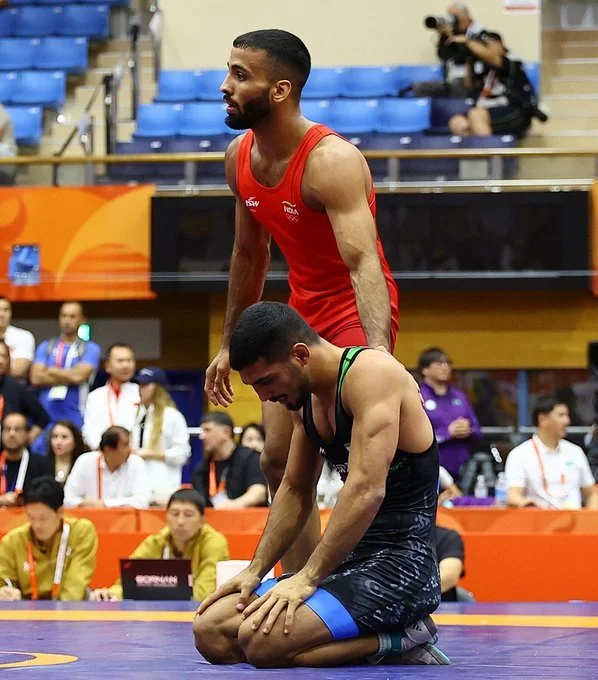
The Tajik built a 9–2 lead, putting Sujeet in the position wrestlers spend their careers trying to avoid: needing multiple scores while knowing that every unsuccessful attack can create another opportunity for the opponent. There was no single seven-point move available to rescue him. Sujeet had to work his way back into the match. The deficit began to shrink. At 9–6, with 1:15 remaining, the gold medal was still some distance away. Another takedown brought him to 9–8. Now the entire final had changed. Kudiev no longer needed more points. He needed time to disappear. Sujeet needed one more opening.
With the final minute running down, he found it. Another takedown put him ahead 10–9 and completed a comeback from seven points behind. Contemporary reports differ slightly on the exact seconds remaining when the decisive action was completed, but agree on the essential sequence: Sujeet erased the 2–9 deficit and took the lead with his final takedown.
A wrestler can desperately want to win and still have no way back into a match. Sujeet had to continue creating scoring positions while under the pressure of a disappearing clock. The comeback required urgency without abandoning the wrestling that could actually produce points. And there is something in Sujeet’s recent history that makes that particularly interesting.
“I Think I Can Manage to Score at Any Moment”
Before the Asian Championships earlier this year, Sujeet spoke to United World Wrestling about another tournament in which he had repeatedly been forced to score late.
At the 2025 U23 World Championships, he won the 65 kg world title after defeating former U23 world champion Bashir Magomedov in the quarterfinal and former U20 world champion Yuto Nishiuchi in the semifinal. Both required scoring in the closing seconds. He then dominated world bronze medalist Umidjon Jalolov 10–0 in the final.
Talking about that run, Sujeet explained something revealing about his approach: “I think I can manage to score at any moment.”
In Nagoya, that belief stopped sounding theoretical. Down 2–9 in an Asian Games final, “any moment” becomes a very small window. He used it anyway.
The Long Way to This Gold
The gold also looks different when placed against the path Sujeet took to reach it.
He was not at the previous Asian Games.
In 2023, Sujeet challenged the decision to give Bajrang Punia direct entry into India’s Asian Games team at 65 kg rather than determining the place through the normal selection process. The Delhi High Court rejected the challenge. Sujeet did not go to Hangzhou.
Then came the attempt to reach Paris 2024. Sujeet and Deepak Punia were travelling to the Asian Olympic qualifier in Bishkek when severe flooding in Dubai disrupted flights. They were stranded at the airport for two days and did not reach the qualifier in time to compete.
There was still one final Olympic qualifying opportunity in Istanbul. Sujeet came close, but close does not send a wrestler to the Olympic Games. His Paris opportunity disappeared.
He went back to wrestling. That matters when looking at Nagoya—not because every setback inevitably produces a future victory. Sport does not work that neatly. Plenty of athletes work through disappointment without ever receiving the ending they hoped for. What matters is what Sujeet did next.
From Almost to Belonging
The transformation became increasingly visible in 2025. At the senior World Championships in Zagreb, Sujeet drew Iran’s Rahman Amouzad, the Paris Olympic silver medalist who would go on to win the world title. Sujeet lost. But only 6–5.
UWW later noted that Sujeet was the wrestler who pushed Amouzad hardest during the Iranian’s championship run. Sujeet himself admitted afterward that he had put too much pressure on himself at his first senior Worlds.
A month later, he became U23 world champion. Then 2026 began to look less like development and more like arrival. He won international events in Zagreb and Tirana. He became Asian champion at 65 kg in Bishkek, defeating Jalolov 8–1 in the final.
By the time he arrived in Nagoya, Sujeet was no longer simply an emerging Indian prospect. He belonged in conversations about the strongest wrestlers in one of freestyle wrestling’s deepest divisions. But there was still a difference between belonging among them and beating them when the stakes were highest. Nagoya provided that test.
Beating the Olympic Champion Matters
The victory over Kiyooka deserves to stand on its own. Olympic champions are beaten. No wrestler remains untouchable forever. But context matters.
Kiyooka was not a fading champion being caught at the end of a cycle. He was the reigning Olympic champion, wrestling in Japan, and Sujeet had to protect the narrowest possible advantage against him. The 3–3 score does not look spectacular beside a 13–3 or 10–0. It may have required more from Sujeet than either. He could not simply overwhelm Kiyooka. He had to understand what the score meant, defend positions, survive attacks at the edge and protect the value of the one two-point action he had created. Then he had to reset. There was still a final to wrestle. And in that final, the problem became almost the opposite. Against Kiyooka, Sujeet had something to protect. Against Kudiev, he had almost nothing left to protect. He had to chase. He proved capable of both.
Beyond the Result
The easiest way to remember Sujeet’s day in Nagoya will be the medal. Gold or perhaps the scores. But numbers flatten what happened. They do not show the difference between dominating an opponent and surviving one. They do not explain what it means to eliminate an Olympic champion on criteria and then, hours later, find yourself seven points behind in a final.
And they certainly do not contain the years before Nagoya: missing one Asian Games team, missing an Olympic qualifier because the journey itself went wrong, falling short of Paris, pushing a future world champion to one point, winning a U23 world title, and gradually moving from prospect to contender.
That is why Sujeet’s gold matters beyond the result. It does not prove that every setback leads somewhere better. Nor does one Asian Games title answer every question about where he ultimately belongs in a 65 kg field containing wrestlers such as Amouzad and Kiyooka. It does show something more immediate. When his route to Hangzhou disappeared, Sujeet kept wrestling. When his route toward Paris disappeared, he kept wrestling. When Kiyooka stood between him and the Asian Games final, he found the score he needed. And when the scoreboard said 9–2 in the biggest match of his day, he kept wrestling again. Eventually, there was nowhere left to come back from. He was ahead. And when the clock finally reached zero, Sujeet Kalkal was the Asian Games champion.
Reporting note: This story draws on official competition results, United World Wrestling reporting and athlete interviews, reporting from The Indian Express and The New Indian Express, and WPR’s review of the 65 kg Asian Games final.