
Elisabeth Diatta Makes History as Senegal Claims Its First Olympic Gold in Beach Wrestling
Dakar 2026 Youth Olympic Games | November 8, 2026
SALY, Senegal — At just 16 years old, Elisabeth Diatta has achieved something no Senegalese athlete had accomplished before her: winning an Olympic gold medal. Competing in front of her home supporters at the Dakar 2026 Youth Olympic Games on Saturday, November 7, Diatta defeated Japan's U17 world champion Reisa Kojima in the women's 55kg beach wrestling final, winning 5–1 by fall. Her victory gave Senegal its first gold in Olympic competition and became an especially meaningful moment for a country where wrestling is deeply rooted in national culture, but women's participation has often received far less attention than the men's sport.
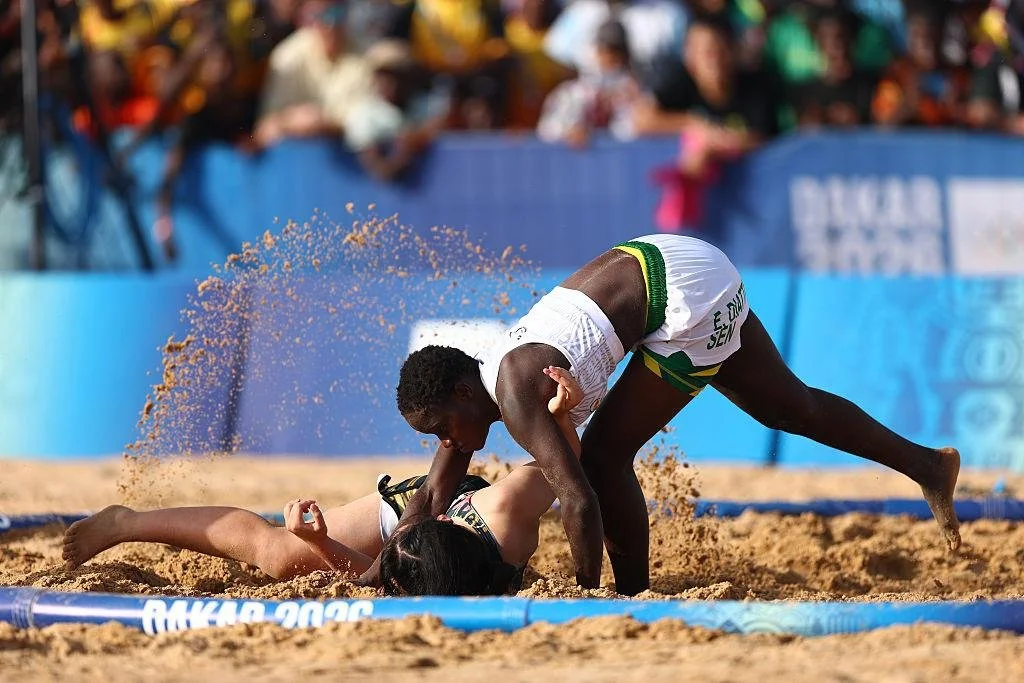
Elisabeth Diatta of Senegal competes against Japan's Reisa Kojima in the women's 55kg beach wrestling final at the Dakar 2026 Youth Olympic Games.
Photo: François Nel / Getty Images
The achievement was even more remarkable considering Diatta's recent international experience. Earlier this year, she had won silver at the U17 African Beach Wrestling Championships before finishing fourth at the U17 World Championships in Baku. In Saly, she faced Kojima, who had won the U17 world title, and overturned the competitive hierarchy established at that earlier championship. The final was not simply an unexpected victory for the host nation; it demonstrated the progress of a young athlete who had already experienced the disappointment of missing a world podium. This time, competing with her family and a passionate home crowd watching, Diatta seized the opportunity to make history.
Wrestling holds a distinctive place in Senegalese society. The country's traditional form of wrestling, known as laamb, has been practised for generations and remains one of its most popular sports. Professional competitions attract large audiences, while wrestling traditions continue to play an important role in local celebrations and community life. In Saly, the sounds of sabar drums and traditional dances accompanied the Youth Olympic competition, connecting the international event with Senegal's own wrestling culture. Although traditional Senegalese wrestling and international beach wrestling operate under different rules, the inclusion of beach wrestling in the Youth Olympics offered the host nation an opportunity to bring this cultural heritage into a new international setting.
For Diatta, the significance of winning gold extends beyond national sporting history. She comes from Casamance in southern Senegal, a region where women have traditionally participated in wrestling alongside men, particularly within local communities. This history stands in contrast to the predominantly male professional wrestling scene that receives much of the country's public attention. After her victory, Diatta encouraged other Senegalese girls to believe in their abilities and continue practising the sport, reminding them that wrestling is not exclusively for men. Her message carried particular weight because Senegal's first Olympic gold had been won by a young woman in a sport so closely associated with masculine strength and national identity.
Behind Diatta's achievement is another important figure in Senegalese women's wrestling: her coach, Isabelle Sambou. A nine-time African champion and former beach wrestling world champion, Sambou represented Senegal at the London 2012 and Rio 2016 Olympic Games, finishing fifth and eighth respectively. She is also from Casamance and has devoted much of her post-competition career to developing young wrestlers, particularly girls. Sambou never won the Olympic medal she had pursued as an athlete, but her work has helped prepare a new generation to compete internationally. Following Senegal's victories, she described the moment as a reward for years of commitment to coaching and developing young talent. Diatta's gold therefore represents not only an individual breakthrough but also the continuation of a history shaped by women who competed, persevered and created opportunities for those who followed them.
Senegal's celebrations continued shortly afterward when another 16-year-old wrestler, Maguette Diop, defeated Azerbaijan's U17 world champion Nihad Suleymanli in the men's 80kg final to secure the country's second gold medal. Like Diatta, Diop overcame a reigning world champion, using a decisive counterattack to complete his victory. The two titles made November 7 a historic day for Senegal, which had previously won only one medal at the senior Olympic Games: Amadou Dia Bâ's silver in the men's 400m hurdles at Seoul 1988. Although the Dakar victories belong to the Youth Olympic Games rather than the senior Olympics, they represent the country's first Olympic gold medals and a significant achievement at the first Olympic event ever hosted on African soil.
Diatta's victory also raises an important question about what comes next for women's wrestling in Senegal. A historic medal can inspire young athletes, but lasting progress depends on access to coaching, training facilities, competition opportunities and continued institutional support. The country's established wrestling culture provides a foundation, while the experience of athletes such as Sambou shows how much dedication has already gone into developing women's participation at the international level. At Dakar 2026, Diatta did more than defeat a world champion to win gold. She brought renewed attention to that history and gave the next generation of Senegalese girls a reason to imagine themselves competing on the same stage.
Wrestling Podium Radio | Beyond the Result