
Redemption and Unfinished Dreams: Haines, Gadzhimagomedov and the Price of Gold
2026 World Wrestling Championships | Astana, Kazakhstan | November 1, 2026
Photo Credit: United World Wrestling (UWW). All photographs featured in this article, including the cover image, are sourced from UWW.
The final two world titles awarded in Astana brought contrasting fortunes for athletes returning to familiar championship situations. American Levi Haines defeated Iran's Mohammad Nokhodi 4–3 at 79kg, turning last year's silver medal into his first senior world gold, while Russia's Amanula Gadzhimagomedov reversed the result of the 2025 final against defending champion Trent Hidlay of the United States with a 3–2 victory at 92kg. Both matches were decided by a single point, illustrating the narrow margins separating the world's leading wrestlers. Yet the consequences were very different for those involved, particularly Nokhodi, whose long pursuit of world gold continued, and Iran's Amirhossein Firouzpour, who left the tournament without a medal despite coming close to reaching the final.
Levi Haines Breaks Through as Nokhodi's Wait Continues
For Haines, the victory represented a significant transformation from his previous World Championships experience. In Zagreb in 2025, the American had reached the 79kg final but lost 3–2 to Greece's Georgios Kougioumtsidis, leaving him with silver and a clear objective for the following season. His return to the final in Astana was not entirely straightforward. After convincing victories in the early rounds, including an 8–1 quarterfinal win over Russia's Ismail Khaniev, Haines survived a difficult semifinal against Mongolia's Suldkhuu Olonbayar. Their match ended 3–3, with the American advancing on criteria after scoring a crucial takedown late in the contest. The narrow escape offered another opportunity to demonstrate the composure needed to succeed when a match cannot be controlled through attacking dominance alone.
Mohammad Nokhodi entered the final with considerably more world championship experience, having already established himself as one of the most consistent medalists in the 79kg division. His record included multiple world silver and bronze medals, yet the senior world title had repeatedly remained out of reach. In Astana, the Iranian again demonstrated the qualities that had carried him to previous finals, surviving a narrow encounter against Belarusian Olympic silver medalist Mahamedkhabib Kadzimahamedau before defeating Azerbaijan's Dzhabrail Gadzhiev 9–5 in the semifinals. Against Gadzhiev, Nokhodi established an early advantage, faced a determined comeback and then used his counterattacking ability to regain control. His performance confirmed that he remained a serious contender for gold, even as another generation of international competitors continued to emerge.
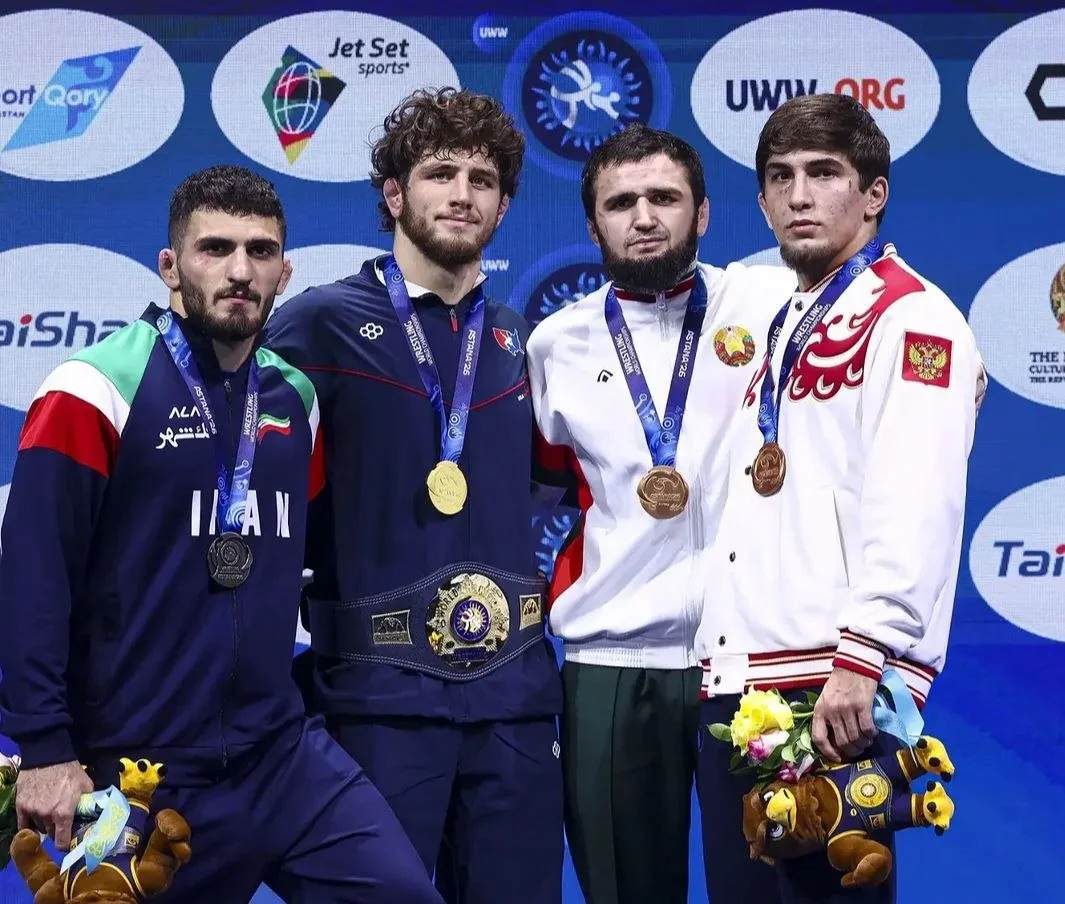
Photo Credit: United World Wrestling (UWW)
The final against Haines, however, ended in another narrow disappointment. The American scored two takedowns and protected his advantage to secure a 4–3 victory, claiming his first senior world title and extending the United States' successful championship campaign. Nokhodi once again stood on the podium with silver, an achievement that reflected his remarkable consistency but also raised familiar questions about the difference between reaching a final and winning it. His repeated appearances in world championship matches cannot be dismissed as failures, especially in a division where even established champions struggle to maintain their position. Nevertheless, the small tactical margins separating him from gold deserve careful examination, particularly in terms of attacking opportunities, defensive decisions and the management of decisive moments against younger opponents.
Gadzhimagomedov Reverses the Outcome of Zagreb
The 92kg final offered a direct rematch of the previous year's championship encounter, when Trent Hidlay defeated Amanula Gadzhimagomedov 13–10 in Zagreb to claim the world title. That high-scoring contest had featured aggressive exchanges and dramatic shifts in momentum, establishing the two wrestlers as formidable rivals in one of freestyle wrestling's most competitive divisions. Their meeting in Astana was therefore an opportunity for Hidlay to defend his title and for Gadzhimagomedov to demonstrate how much he had adapted since the previous defeat. The Russian had advanced through a difficult semifinal against Georgia's Miriani Maisuradze, winning 3–2, while Hidlay had endured one of the tournament's most dramatic comebacks to reach the final.
Against Iran's Amirhossein Firouzpour in the semifinals, Hidlay had fallen behind 8–2 and appeared to be in serious danger of losing his opportunity to defend the title. The American responded with a takedown followed by successive leg-lace turns, eliminating the deficit before taking control of the closing stages to secure an 11–8 victory. Firouzpour's early advantage had placed him in a strong position to reach the final, but the rapid reversal demonstrated how vulnerable even a substantial lead can become when an opponent successfully establishes a turning position. For Hidlay, the victory was a remarkable display of resilience; for Firouzpour, it was a painful missed opportunity that would ultimately shape the conclusion of his championship.
The rematch between Hidlay and Gadzhimagomedov unfolded very differently from their meeting in Zagreb. Rather than another high-scoring contest, the final became a tightly controlled tactical battle in which scoring opportunities were limited and every point carried considerable significance. Gadzhimagomedov prevailed 3–2, securing his first senior world title and reversing the outcome of the previous year's final. His victory illustrated how the balance between familiar opponents can shift through tactical adjustments, especially when the athletes understand each other's preferred scoring positions. Hidlay's silver added another world medal to his record, but the narrow defeat denied him the opportunity to become a consecutive world champion.
For Firouzpour, the disappointment continued in the bronze-medal match, where Azerbaijan's Ali Tcokaev defeated him 6–0, leaving the Iranian in fifth place. The result was especially frustrating given how close he had come to eliminating the defending champion in the semifinals. His experience highlighted the unforgiving nature of world championship wrestling, where one unsuccessful defensive sequence can change the direction of a tournament and where recovering from such a defeat presents another demanding challenge. Firouzpour's performance also raised questions worth examining beyond the immediate result, particularly the technical and tactical decisions that allowed Hidlay to reverse a six-point deficit.
Beyond the Final Score
Haines and Gadzhimagomedov left Astana with the titles that had escaped them in 2025, demonstrating how previous disappointment can become a foundation for future success. Nokhodi, Hidlay and Firouzpour experienced different forms of frustration, despite showing the ability to compete with the world's best. Their stories also helped define a historic championship for the United States, which finished with seven gold medals across all three wrestling styles, one more than Iran, and secured the outright highest gold-medal total at a full World Championships for the first time.
The contrasting outcomes at 79kg and 92kg offer important subjects for further technical discussion. Haines' ability to manage a narrow advantage, Nokhodi's continued struggle to convert world finals into gold, Gadzhimagomedov's adjustments against a familiar opponent and Hidlay's dramatic semifinal comeback all reveal aspects of wrestling that cannot be understood through results alone. As the championships conclude, these moments remain valuable opportunities to examine how technique, experience, tactical decisions and the pressure of competition shape the difference between winning a world title and leaving the mat with unfinished ambitions.
Wrestling Podium Radio | Beyond the Result