
Twenty-Six Seconds to Glory: Lee's Triumph, Mexico's Milestone and Sheriev's Rise
2026 World Wrestling Championships | Astana, Kazakhstan | November 1, 2026
The final day of the 2026 World Wrestling Championships in Astana delivered two contrasting stories at 57kg and 74kg. Spencer Lee of the United States needed only 26 seconds to secure his first senior world title, while Russia's Inalbek Sheriev defeated home favourite Nurkozha Kaipanov 10–4 to claim gold in a division featuring several established international medalists. Beyond the victories, the closing session also marked a historic breakthrough for Mexican wrestling through Roman Bravo-Young and a hard-earned bronze medal for Iran's Amirmohammad Yazdani, who recovered from a disappointing quarterfinal defeat to finish on the podium.
Spencer Lee: A Long Journey to a 26-Second Victory
For Spencer Lee, the extraordinary speed of his 10–0 victory over Roman Bravo-Young was in sharp contrast to the difficult journey that preceded it. The Olympic silver medalist from Paris 2024 had spent much of his career dealing with serious knee injuries and the frustration of falling short of a senior world championship title. Another injury earlier in 2026 raised questions about his ability to return to peak competitive form, but Lee arrived in Astana determined to complete the achievement that had eluded him. His route to the final included dominant performances against Iran's Milad Valizadeh and Russia's Abubakar Mutaliev, although the semifinal against Azerbaijan's Islam Bazarganov nearly brought his campaign to an abrupt end.
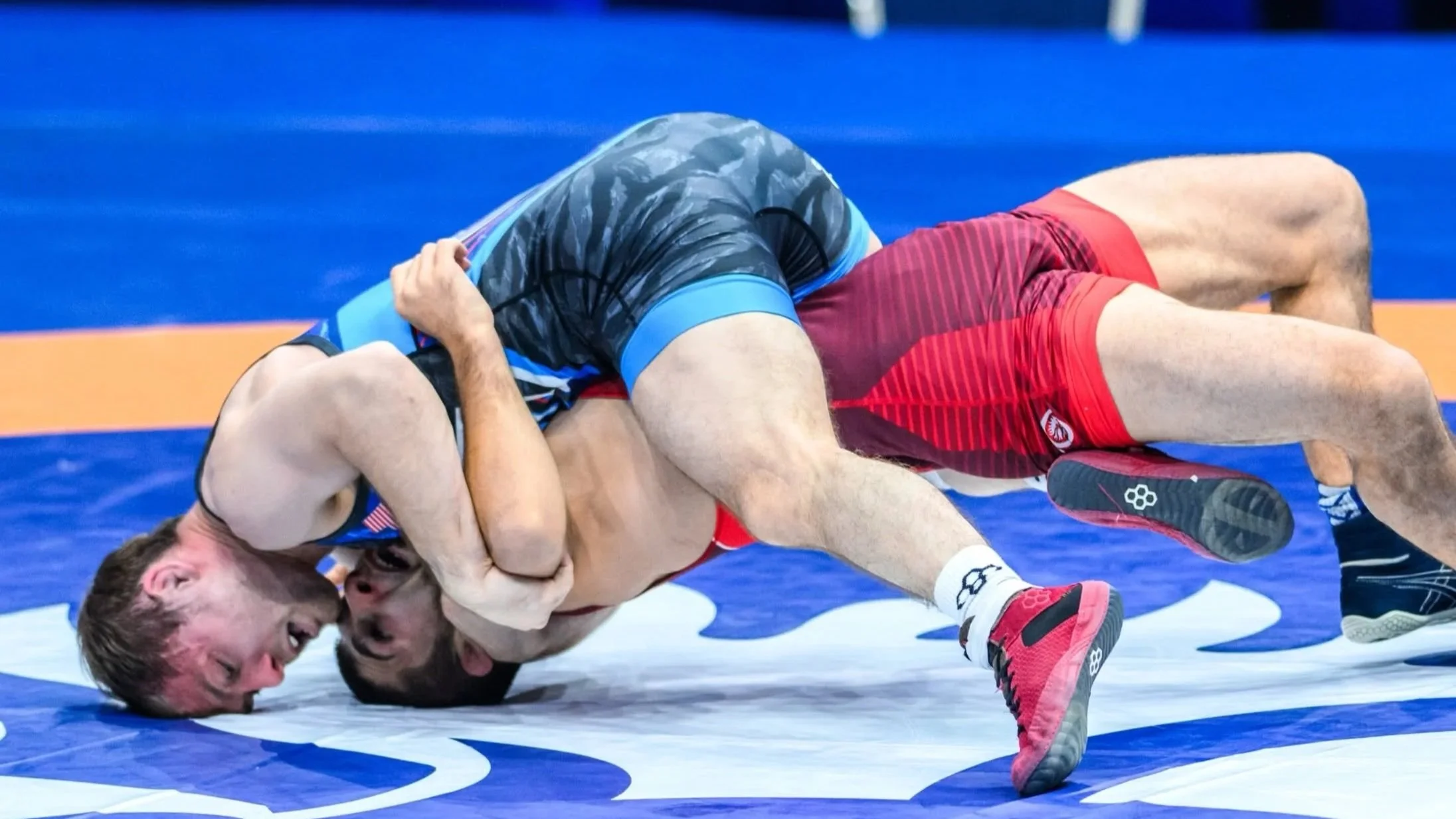
Photo Credit: Tony Rotundo / Wrestlers Are Warriors
Trailing 10–5 after Bazarganov repeatedly exposed him through gut-wrench attacks, Lee found himself dangerously close to elimination. Instead, he countered his opponent and secured a fall, transforming a near-defeat into a place in the championship match. The final unfolded very differently. Lee attacked immediately, converted his opening opportunity into a takedown and completed four consecutive leg-lace turns to win by technical superiority in approximately 26 seconds. The performance was a remarkable demonstration of technical precision, but its significance extended far beyond the time displayed on the clock. A decade after his junior world success, Lee had finally claimed the senior world title that years of injuries and setbacks had repeatedly placed beyond his reach.
Despite the decisive defeat, Bravo-Young left Astana with an achievement of historic importance. The two-time NCAA champion, who previously represented the United States before competing internationally for Mexico, became the first wrestler representing Mexico to win a senior World Championships medal. His path to silver included a 4–1 semifinal victory over North Korea's defending champion Chongsong Han, an opponent who had defeated him at the previous championships. While the final exposed the considerable challenge of facing a wrestler of Lee's calibre, Bravo-Young's tournament demonstrated the growing potential for Mexico to establish a stronger presence in international wrestling. His silver medal represented not only personal progress but also a milestone for a country seeking greater recognition in the sport.
Sheriev Denies Kaipanov a Home-Crowd Gold
The 74kg final carried a different historical significance, particularly for Kazakhstan's Nurkozha Kaipanov. Seven years earlier, he had reached the world final in the same city, then known as Nur-Sultan, and finished with silver. Since then, Kaipanov had captured the 2024 world title at 70kg and added bronze in 2025, establishing himself among the most consistent competitors of his generation. Returning to Astana at 74kg offered an opportunity to claim another gold medal in front of his home supporters. His opponent, Inalbek Sheriev, had also moved up from 70kg, where he earned world bronze in 2024, and entered the final seeking the first senior world title of his career.
Sheriev's path through the tournament demonstrated both attacking confidence and tactical discipline. After defeating American veteran James Green 10–0, he pinned Iran's Amirmohammad Yazdani in the quarterfinals with a pancake counter before overcoming Slovakia's experienced Tajmuraz Salkazanov 3–1 in the semifinals. Kaipanov had also advanced impressively, including a commanding victory over Tajikistan's Viktor Rassadin, but he could not prevent Sheriev from taking control of the championship match. The Russian secured a 10–4 victory, completing his progression from world bronze medalist at 70kg to world champion at 74kg. For Kaipanov, another silver in Astana was undoubtedly disappointing, although his ability to remain among the world's best across seven years and two weight categories remained a significant accomplishment.
The bronze-medal competition produced another compelling story through Amirmohammad Yazdani, whose quarterfinal defeat by fall against Sheriev had abruptly changed the direction of his tournament. Once Sheriev reached the final, Yazdani returned through repechage, defeated James Green and then overcame Salkazanov 5–4 in a closely contested bronze-medal bout. The result earned the Iranian his first world medal at 74kg, adding to two previous silver medals at lighter weights. His recovery also provided a reminder that a single dramatic defeat does not have to define an athlete's championship, particularly when the ability to regain composure becomes as important as technical preparation.
The two divisions ultimately presented different expressions of achievement. Lee's victory reflected the culmination of years of perseverance, while Bravo-Young's silver opened a new chapter for Mexican wrestling. Sheriev demonstrated the potential of a successful transition between weight categories, Kaipanov reinforced his reputation for longevity, and Yazdani turned a damaging defeat into a place on the podium. Their experiences illustrated why the significance of a World Championships extends beyond the final score: each medal carries a history shaped by previous opportunities, difficult decisions and the ability to respond when a tournament takes an unexpected turn.
Wrestling Podium Radio | Beyond the Result