
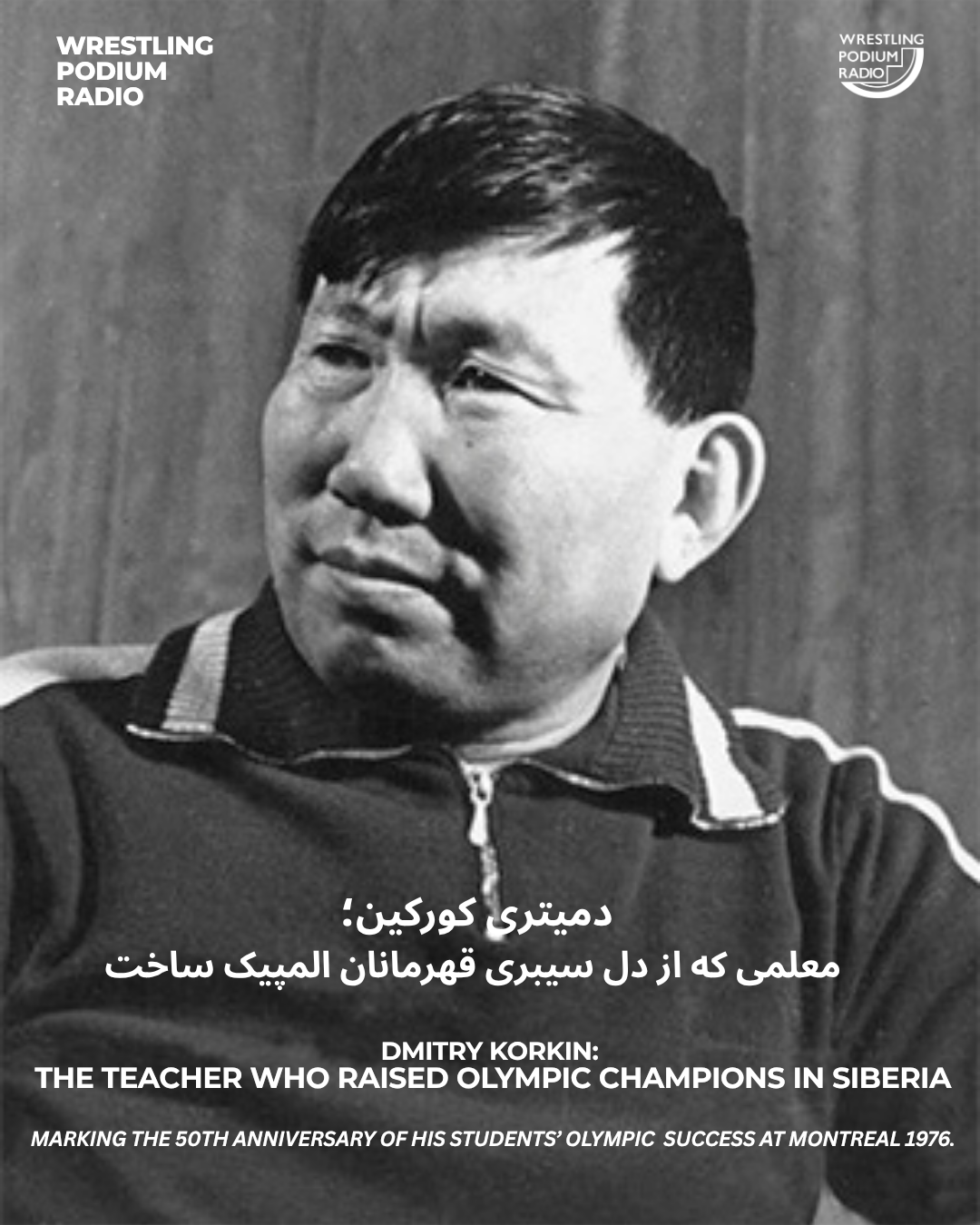
Dmitry Korkin: The Teacher Who Built a Wrestling School in Siberia
Fifty years after three of his students stood on the Olympic podium in Montreal, Yakutia celebrates the legacy of one of its most influential wrestling coaches.
The international freestyle wrestling tournament in memory of Dmitry Korkin concluded on November 21 in Yakutsk, bringing together 229 wrestlers from 12 countries. This year's competition marked two anniversaries in the sporting history of the region: seventy years of freestyle wrestling in Yakutia and fifty years since three of Korkin's students won medals at the 1976 Montreal Olympic Games.
The story behind the tournament begins in the mid-1950s, when a young schoolteacher returned from Leningrad to his native region in northeastern Siberia and began teaching freestyle wrestling.
From Teaching Literature to Coaching Wrestling
Born in 1928 in the Churapcha district of Yakutia, Dmitry Petrovich Korkin lost both his parents at the age of six. He later attended the Herzen Pedagogical Institute in Leningrad, graduating in 1956 as a teacher of Russian language and literature. During his studies, he also became an accomplished sambo wrestler, winning the Leningrad city championship. Despite his potential as a competitive athlete, he chose to return to Yakutia and pursue a career in education.
While working as a teacher and deputy headmaster in Ozhulun, Korkin established wrestling programmes for schoolchildren and adults in neighbouring communities. He gradually shifted his professional attention towards physical education, and in 1966, at his initiative, a sports boarding school was established in Churapcha. The school allowed young wrestlers to combine their education with regular athletic training and provided a foundation for the long-term development of wrestling in the region.
The Cultural Roots of Wrestling in Yakutia
Freestyle wrestling was relatively new to Yakutia in the 1950s, but wrestling itself had been part of the culture of the Indigenous Sakha people for centuries. Their traditional form of wrestling, known as Khapsagai, is primarily a standing discipline in which wrestlers attempt to force their opponents to touch the ground. It has traditionally been practised during Ysyakh, the Sakha summer festival.
The development of modern freestyle wrestling in Yakutia cannot be separated from this cultural background. Korkin worked within a society where wrestling already had a recognised place in community life. His contribution was to establish a systematic approach to athletic education that enabled local wrestlers to compete within the Soviet sporting system and eventually at the international level.
For regions with strong traditional wrestling cultures, including parts of Iran, Mongolia and Central Asia, the experience of Yakutia offers an interesting historical example of how local sporting traditions can support the development of Olympic wrestling.
A Training Method Developed in Yakutia
Korkin's coaching methods reflected both his educational background and the conditions in which his athletes lived. In an interview published by TASS in 2019, Alexander Ivanov, one of his Olympic medallists, recalled that Korkin introduced three daily training sessions when the Soviet national team was generally training twice a day. His approach, however, was not based simply on increasing the volume of training. Ivanov also remembered his coach's ability to recognise when an individual athlete needed a lighter workload.
Korkin developed his own wooden training equipment, including devices inspired by the physical movements of construction workers. He also paid close attention to nutrition, incorporating locally available foods such as meat, fish and berries into his wrestlers' diets. These methods reflected a practical understanding of the environment in which his athletes were growing up and training.
His work as an educator extended well beyond competitive wrestling. According to biographical information published by the Russian Museum, 175 of the 448 wrestlers trained at his school earned the Soviet title of Master of Sport, while 265 pursued and completed higher education.
From Munich to Montreal
The first Olympic gold medal of Korkin's coaching career came in 1972, when Roman Dmitriev won the 48 kg freestyle title in Munich, becoming Yakutia's first Olympic champion.
Four years later, at the 1976 Montreal Olympic Games, three wrestlers from Korkin's school represented the Soviet Union and returned with medals. Pavel Pinigin won gold in the 68 kg category, Roman Dmitriev earned silver at 48 kg, and Alexander Ivanov took silver at 52 kg.
The achievement was particularly significant given the strength of Soviet wrestling at the time. The Soviet Union won five gold medals and eight medals overall in freestyle wrestling in Montreal. Three of those eight medals came from wrestlers developed at the same school in Churapcha.
The Olympic achievements also changed the place of freestyle wrestling within Yakutia. Ivanov recalled that interest in the sport spread throughout the region following the Montreal Games. For young wrestlers in rural communities, Olympic success was no longer something associated exclusively with athletes from the major sporting centres of the Soviet Union.
A Legacy Documented in Art
An unusual record of Korkin's work can be found in the collection of the National Art Museum of the Republic of Sakha. In 1971, Yakut artist Afanasy Osipov completed an oil painting depicting Korkin surrounded by his students at the Churapcha wrestling school.
The painting predates both Dmitriev's Olympic victory in Munich and the achievements of the three wrestlers in Montreal. Its subject is the coach and his students during training, rather than an Olympic victory. It provides an interesting cultural record of the recognition Korkin's educational work had already received before his school achieved its greatest international successes.
Following Korkin's death in 1984, his legacy continued through the institutions he helped establish. A Soviet memorial tournament was organised in 1987, his former home became a museum in 1988, and the Churapcha sports boarding school was named in his honour in 1991.
The 2026 Korkin Memorial
This year's memorial tournament, held on November 20 and 21 at the Triumph Sports Complex in Yakutsk, attracted a record number of participants. Among the most prominent competitors was Tokyo Olympic bronze medallist Artur Naifonov, who won the 86 kg title and was named the tournament's outstanding wrestler.
Former world medallist Aryan Tsiutryn of Belarus claimed the 57 kg title, Japan's Akito Mukaida won at 61 kg, and Azerbaijan's Muhamad Gantemirov took gold at 125 kg. The remaining seven titles went to wrestlers representing Russian regional teams. Local wrestler Igor Matveev won the 70 kg category, securing a title for the host region.
Fifty years after Montreal, Korkin's contribution remains relevant to discussions about grassroots wrestling and athlete development. His experience demonstrates the importance of local coaches, access to education and sustained investment in young athletes. The three Olympic medals won in Montreal were the most visible achievement of a project that had begun twenty years earlier in the schools and villages of Yakutia.
Sources
History of Yakutia – Dmitry Petrovich Korkin — biography and educational career.
TASS – From Khapsagai to the World Cup — Alexander Ivanov's recollections and Korkin's training methods.
Olympedia – Montreal 1976 Wrestling — Olympic results.
Russian Museum – Korkin and His Students — the 1971 painting and history of the wrestling school.
Echo of the Capital – 2026 Korkin Memorial Results — this weekend's competition.
Dzulurgan – Korkin 2026 — full results and outstanding wrestler award.