
The Champion and the People: Hassan Yazdani and the Cultural Power of Wrestling in Iran
Hassan Yazdani’s dramatic Olympic gold in Rio was more than the story of a six-point comeback. In a country where wrestling carries generations of history, identity and expectation, the final offered another glimpse of the powerful bond between Iranian wrestlers and the people who follow them.
More Than an Olympic Final
RIO DE JANEIRO — Hassan Yazdani was running out of time.
The 21-year-old Iranian had entered the Olympic 74 kg final after a dominant day, but against Russia’s Aniuar Geduev the match had taken a very different direction. Three first-period takedowns put Geduev ahead 6–0.
Yazdani spent the second period trying to erase the deficit. One takedown. Then another. With only seconds remaining, he scored again. The match ended 6–6, and Yazdani took the Olympic title on criteria. Iran had its first Olympic freestyle wrestling champion in 16 years.
It was an extraordinary comeback. But for Iran, moments like this in wrestling rarely belong only to the wrestler standing on the mat.
A Sport Woven Into a Culture
Wrestling holds a distinctive place in Iranian sporting culture. Its importance stretches beyond international medals and championship tables. For generations, the wrestler has also existed in the Iranian imagination as a cultural figure — associated not simply with physical strength, but with ideas of courage, humility, resilience and responsibility toward others.
That history changes the meaning of an Olympic wrestling final.
The athlete may compete alone, but he does not necessarily feel alone.
In Rio, Iranian supporters were impossible to separate from the atmosphere surrounding Yazdani’s final. They had come to watch a young wrestler from Mazandaran, one of the country's great wrestling regions, attempt to return an Olympic freestyle gold to Iran after a 16-year absence. Contemporary reports described a large and vocal Iranian presence inside Carioca Arena 2.
When Yazdani came back from six points down, the reaction therefore belonged to more than one athlete.
It belonged to the people in the stands, and to countless others following from home.
The Wrestler and the People
There is something revealing in the images surrounding Iranian wrestling.
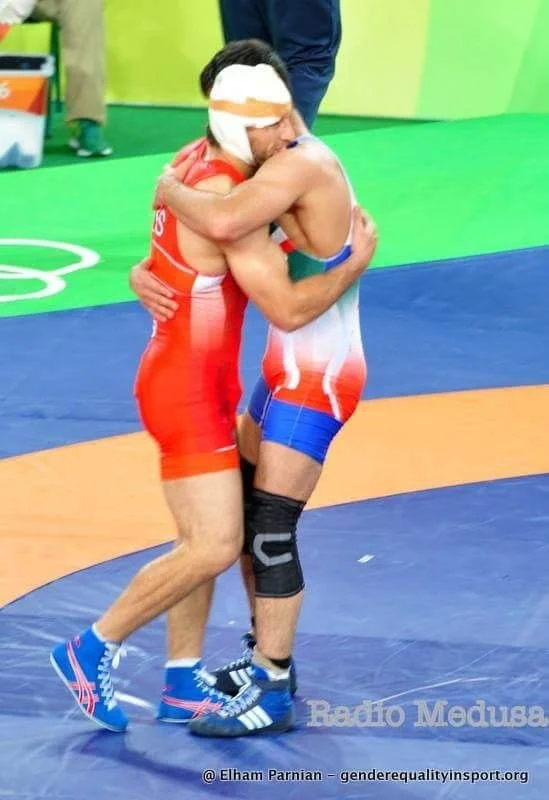
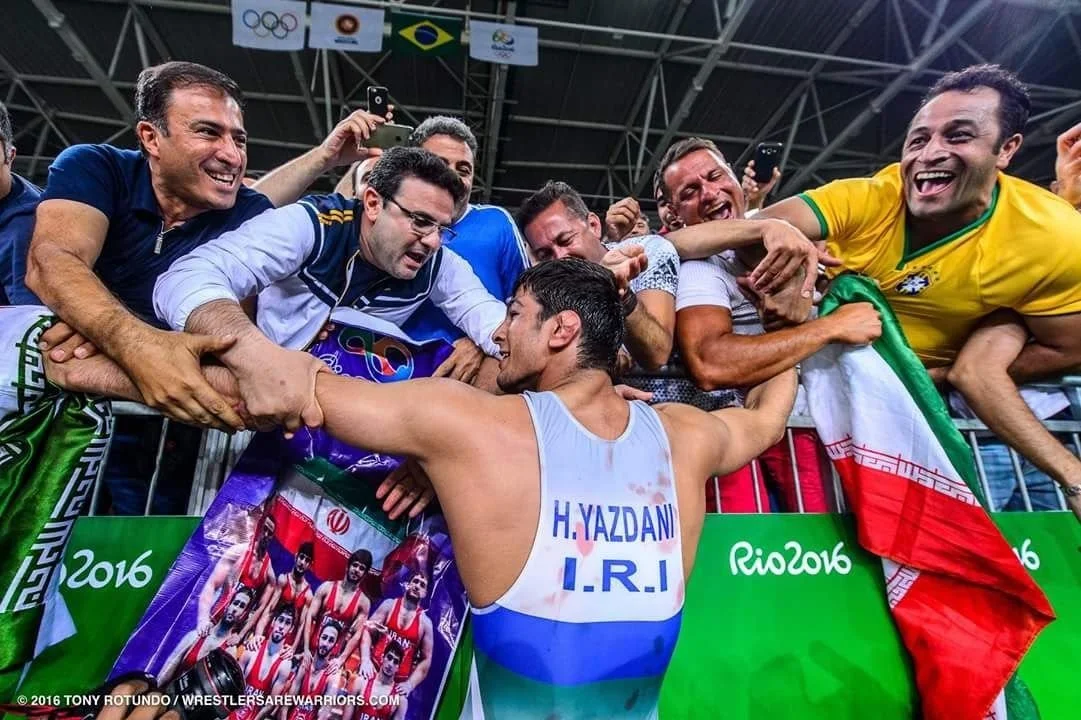
The embrace with a coach. The wrestler looking toward the stands. Supporters reaching toward the athlete from behind the barrier.
They show a sport in which the distance between champion and supporter can become remarkably small.
Yazdani had already established himself internationally before arriving in Rio, including a senior World Championship silver medal in 2015. But Olympic gold carries a particular weight, especially in a wrestling nation.
And perhaps the manner in which this one was won made the connection even stronger.
Six points behind. An Olympic title slipping away. Seconds remaining. Then one final takedown.
For supporters, those moments create memories that cannot be reduced to technique or statistics. They become stories retold between generations: where people were watching, how they reacted, and what they felt when the result changed.
When a Medal Belongs to More Than One Person
An Olympic medal is awarded to an individual. Its meaning does not always remain individual.
In Iran, wrestling has long provided a space where sport, history and ideas about national identity meet. Champions are celebrated for winning, but the relationship between wrestler and public can demand something more than medals. That is why the final image of Yazdani’s night in Rio does not have to be the scoreboard. It can be the people.
A young wrestler had just completed one of the most dramatic comebacks of the Olympic wrestling tournament. Around him were supporters celebrating a gold medal they would never physically wear, but which they could nevertheless experience as partly their own.
Hassan Yazdani won the Olympic title on the mat. The celebration around him showed why, in Iranian wrestling, a victory can belong to far more than the wrestler alone.