
Beyond Fifth Place: What Is Holding Canadian Wrestling Back?
Despite individual talent and occasional medal opportunities, Canadian wrestling continues to struggle at the highest international level. Is the problem bigger than the athletes?
Canada has not won an Olympic wrestling medal since Erica Wiebe's gold at Rio 2016. Its last senior world champion was Linda Morais in 2019. For Canadian men's freestyle wrestling, the wait has been considerably longer: no senior world medal since Gia Sissaouri's gold in 2001.
Recent results offer occasional signs of promise. Peiman Biabani reached a world bronze-medal match in 2025, and Lachlan McNeil did the same in 2026. Both finished fifth. Canada's women have continued to produce international medallists, but consistent success at the senior level remains difficult.
The question goes beyond individual results. What is preventing Canadian wrestling from producing more consistent performances against the world's leading nations? And how much of the answer lies in athlete development, technical preparation, funding and the structure of the national high-performance program?
A Pattern That Goes Beyond Fifth Place
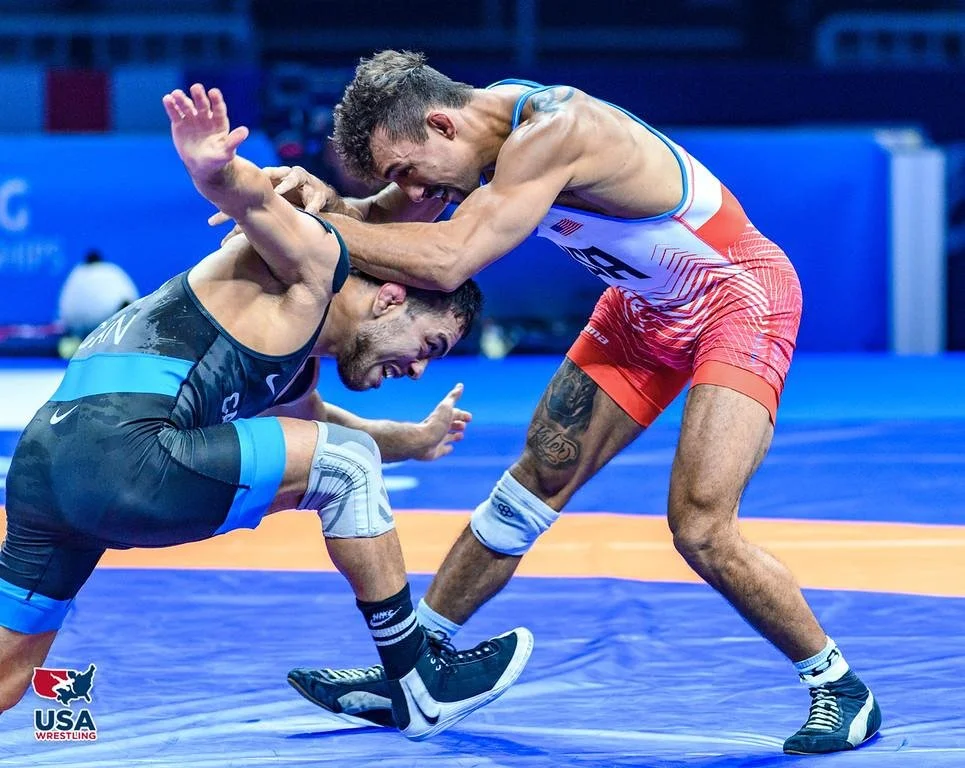
Peiman Biabani vs. Real Woods — Zagreb 2025 | Source: USA Wrestling Event Photography
Between 2022 and 2026, Canada won three senior World Championship medals, all bronze and all in women's wrestling. Karla Godinez Gonzalez and Linda Morais reached the podium in 2022, followed by Laurence Beauregard in 2025.
In men's freestyle, the absence of world medals has extended across generations. Even when wrestlers reach bronze-medal matches, the final step has remained difficult.
Biabani's fifth-place finish at 65 kg in Zagreb came after a narrow 3–1 defeat to American Real Woods. A year later, McNeil lost 4–0 to former world champion Zain Retherford at 70 kg in Astana.
Both opponents were formidable. A fifth-place finish at this level should not be dismissed. Yet after twenty-five years without a men's world medal, these results raise questions about the ability of the Canadian program to consistently prepare wrestlers for the highest level of competition.
Talent Developed Through Different Systems
The backgrounds of Biabani and McNeil make this question particularly interesting. Biabani arrived in Canada with considerable international experience, having won the 2016 Junior World Championships while representing Iran. His technical foundation was established within Iran's highly competitive wrestling environment.
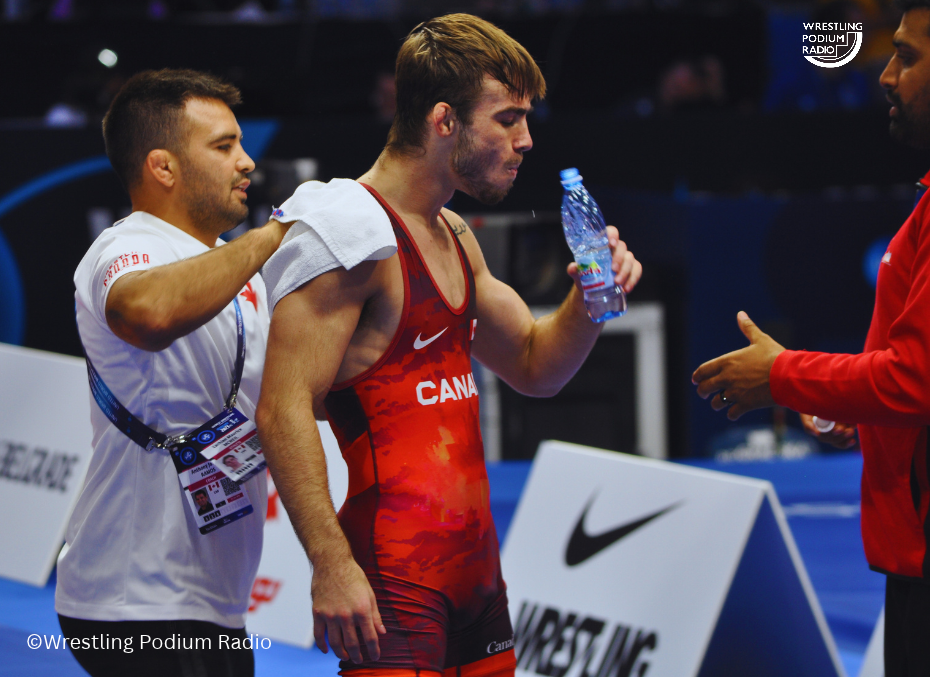
Lachlan McNeil with his former coach, Tony Ramos, at the 2023 World Wrestling Championships in Belgrade, Serbia. | Photo © Wrestling Podium Radio - 2023
McNeil followed a different path. After developing in Canadian wrestling, he spent much of his collegiate career in the United States, competing for North Carolina and Michigan. He became a four-time NCAA All-American before finishing fifth at the 2026 Worlds. Their experiences are not identical, and both have continued developing through Canadian wrestling clubs and international competition. But neither represents an exclusively Canadian training pathway.
This raises an uncomfortable question: If some of Canada's strongest male competitors have benefited significantly from wrestling systems abroad, what does that tell us about the country's own high-performance development structure?
Funding, Coaching and International Preparation
Financial resources are part of this discussion. Wrestling Canada Lutte's revised club-coach funding framework acknowledges limited resources and anticipates reduced external support. Beginning in 2026–27, participating clubs are expected to contribute an increasing share of eligible coaching funding, subject to annual review.
The concern extends beyond coaching salaries. International success requires access to strong training partners, regular competition against leading wrestling nations, technical analysis and long-term athlete development. Countries with deep wrestling traditions and well-funded programs can offer environments where elite competition is part of everyday preparation. Canadian athletes often have to seek additional opportunities through international camps, foreign clubs or American universities. Whether those opportunities are sufficient, and whether the national program can provide consistent technical and tactical support, deserves closer examination.
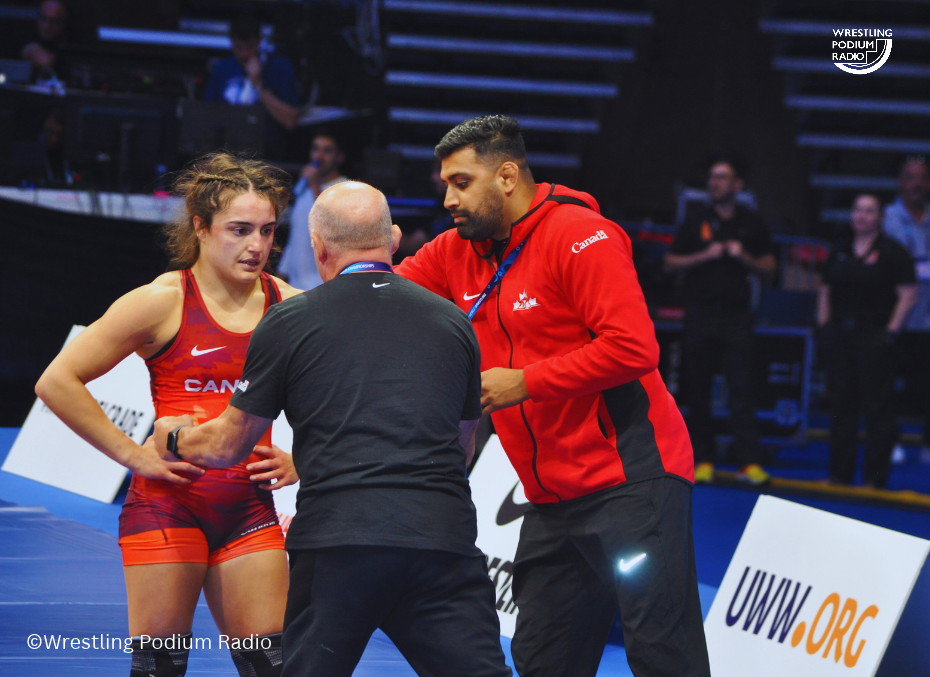
Karla Godinez Gonzalez with members of the Canadian coaching staff at the 2023 World Wrestling Championships in Belgrade. | Photo © Wrestling Podium Radio
What Needs to Change Before LA28?
The results alone cannot establish whether Canada's difficulties are primarily financial, technical or managerial. Nor do they tell us exactly why Biabani or McNeil lost their bronze-medal matches. That would require closer examination of their wrestling, preparation and support systems.
But the longer record is difficult to ignore. Canada has produced talented wrestlers, experienced coaches and successful age-group athletes. Its women have continued to win world medals, although Olympic success has remained elusive since 2016. Its men's program has gone a quarter-century without a senior world medal.
With Los Angeles 2028 approaching, the question should not be limited to which wrestlers can qualify for the Games.
What changes are needed in Canada's high-performance system to give those athletes a realistic chance of reaching the podium?
Answering that question requires more than another championship result. It requires a closer look at funding priorities, coaching development, international preparation and the decisions shaping Canadian wrestling's future.